The Five Carries™: What Are You Carrying — and Is It What Matters Most?

By Philip Blackett | Founder of Life After 40® and Author of The Five Carries™
What happens when the life you've worked so hard to build becomes more than you can carry?
Think about that question for a moment.
You've spent years building a career, raising a family, strengthening relationships, pursuing your ambitions, and working toward a better future.
Along the way, you've accumulated responsibilities.
Some you willingly accepted. Others arrived without asking your permission.
You're responsible to your family. Your employer. Your employees. Your customers. Your aging parents. Your children. Your friends. Your community.
And somewhere in the middle of meeting everyone else's expectations, you may have forgotten one important person.
The person carrying everything else.
You.
It's an uncomfortable realization, especially when you've spent much of your adult life defining success by how much you accomplish and how many people can depend on you.
But I've come to believe that one of the most important questions we can ask ourselves, particularly in the second half of life, isn't simply, "What more can I accomplish?"
It's something deeper.
"What am I carrying?"
That question became the foundation of The Five Carries™, a five-book parable series and practical personal development framework I created to help people better understand their responsibilities, relationships, purpose, and human capacity.
The Five Carries framework identifies five directions of responsibility that influence how we live, work, lead, parent, and prepare for the future: Carry Up, Carry Down, Carry Across, Carry Forward, and Carry Within.
And now, I'm excited to share that The Five Carries™ book series is available on Amazon in Kindle, paperback, and hardcover formats.
But before I introduce the five books, I want to share why I wrote them, what this framework means, and how it might change the way you approach your own life.
Why I Wrote The Five Carries: My Journey from Midlife Crisis to Midlife Comeback
For many people, Thanksgiving is an opportunity to reflect on everything they're grateful for.
That year, it became something more personal.
It forced me to reflect on my life.
I had accomplished many things I once dreamed about. I had earned degrees, worked for recognizable organizations, built professional relationships, become a husband and father, and experienced both successes and setbacks.
On paper, there was plenty to celebrate.
But internally, I had questions.
Was I where I thought I would be at 40?
Was I becoming the man I wanted to be?
What kind of husband and father was I becoming?
Was I taking care of my health as intentionally as I was pursuing professional success?
And perhaps most importantly:
If I had another 40 years to live, how could I make those years even BETTER than the first 40?
Those questions eventually inspired me to expand Life After 40® around a simple mission:
Help end the midlife crisis globally by empowering people to thrive in the second half of life.
Through Life After 40, I began focusing on four foundational pillars of sustainable health and wellness: Nutrition, Exercise, Mindset, and Recovery.
But as my work expanded into coaching, corporate education, leadership development, sustainable high performance and human capacity, something became increasingly clear.
The challenges people face in midlife aren't limited to their physical health.
Sometimes, the problem isn't what they're eating.
Sometimes, it isn't how often they're exercising.
Sometimes, it isn't even how many hours they're sleeping.
Sometimes, the challenge is everything they're carrying.
The responsibilities they're afraid to release.
The expectations they've never questioned.
The people they feel obligated to rescue.
The relationships they're trying to preserve.
The future they're working so hard to create.
And the personal needs they keep postponing.
I began thinking about the relationships between responsibility, identity, success, and sustainable high performance.
Why do capable people sometimes feel overwhelmed by lives that appear successful?
Why do managers struggle under the weight of expectations coming from every direction?
Why do parents find it difficult to let their children experience challenges?
Why do leaders invest so much energy into building organizations while sometimes neglecting themselves?
And why do some people approach retirement with financial plans but little clarity about their identity and purpose?
These questions appeared different on the surface.
But beneath them, I saw a common theme.
People weren't simply struggling with what they were doing. They were struggling with what they were carrying.
And that's where The Five Carries began to take shape.
What Is The Five Carries™ Framework?
The Five Carries™ is a personal development, management, and leadership framework created by me (Philip Blackett) that organizes responsibility into five interconnected directions.
It helps individuals examine who and what they are responsible for, where their energy is going, which commitments deserve their attention, and what they may need to share, change, or release.
The five directions are:
Carry Up: Our responsibilities toward those above us or those who came before us.
Carry Down: Our responsibilities toward those who depend on us.
Carry Across: Our responsibilities within our relationships with peers, partners, and equals.
Carry Forward: Our responsibilities toward the future, the next generation, and the legacy we leave behind.
Carry Within: Our responsibility to develop and care for ourselves, so we can sustain the other four Carries.
Every direction represents a different kind of responsibility.
And although the responsibilities change depending on our circumstances, the five directions remain relevant throughout our lives.
For example, Carry Up might mean managing expectations from senior executives at work. At home, it might mean honoring aging parents or understanding the cultural traditions and family values we inherited.
Carry Down might mean developing employees on your team. As a parent, it might mean guiding your children toward independence.
Carry Across might involve collaborating with colleagues, maintaining friendships, or strengthening your marriage.
Carry Forward involves achieving your goals and preparing for what comes next, whether that's succession planning, raising the next generation, or redefining your purpose in retirement.
And Carry Within reminds us that none of these responsibilities can be sustained indefinitely if we continually neglect the person carrying them.
The framework is not designed to eliminate responsibility.
Responsibility is an important part of living a meaningful life.
Instead, The Five Carries helps us become more intentional about what we carry, how we carry it, who carries it with us, and what we eventually need to stop carrying.
Let's explore each direction.
The Five Carries™ Explained: Five Directions of Responsibility
1. Carry Up: Honor What Came Before You Without Being Controlled by It
Nobody begins life from scratch.
We inherit values, beliefs, lessons, opportunities, traditions, expectations, and experiences from those who came before us.
Our parents, grandparents, teachers, mentors, managers, and other influential people help shape who we become.
Some of what we inherit empowers us.
Other things may limit us.
Carry Up is about understanding and honoring those influences while recognizing that respect does not require surrendering our judgment or future.
At work, Carry Up means communicating effectively with senior leadership, managing expectations, and providing honest feedback rather than simply saying what people want to hear.
In our personal lives, it might involve caring for aging parents, honoring family traditions, or examining beliefs we've carried since childhood.
But there's an important distinction:
Honoring your past doesn't mean allowing your past to dictate your future.
You can appreciate what someone taught you without repeating every decision they made.
You can respect authority while maintaining your integrity.
You can be grateful for your upbringing while choosing a different path for your children.
Reflection question: What beliefs, expectations, or responsibilities have I inherited that I need to preserve, reconsider, or release?
2. Carry Down: Develop Those Who Depend on You Without Carrying Everything for Them
If you're a parent, manager, mentor, caregiver, or leader, chances are someone depends on you.
That's a privilege.
But it also creates responsibility.
Carry Down focuses on how we support, protect, guide, and develop those entrusted to our care and stewardship.
The challenge is recognizing the difference between helping someone and preventing them from growing.
Consider the parent who solves every problem for their child because they don't want to see them struggle.
Or the manager who constantly takes unfinished work away from employees because doing it personally seems faster and more efficient.
Both may have good intentions.
But constantly carrying responsibilities that others need to learn to manage can create dependency rather than development.
One of the most important lessons within The Five Carries is this:
The goal isn't to make people dependent on your strength. It's to help them develop their own.
Sometimes, responsibility means stepping in.
Sometimes, it means walking alongside someone.
And sometimes, it means stepping back, so they can grow.
For parents, that might involve allowing a teenager to experience the consequences of a poor decision made at school.
For managers, it might mean coaching an employee through a difficult assignment rather than completing it for them.
For leaders, it means preparing people to succeed without your constant involvement.
Reflection question: Am I helping the people who depend on me become more capable, or am I unintentionally teaching them to depend on me for everything?
3. Carry Across: Build Relationships That Share Responsibility Rather Than Multiply It
Life wasn't designed to be lived entirely alone.
Yet many high achievers struggle with the idea of asking for help.
They believe being "dependable" means having ALL the answers.
Being "strong" means never admitting weakness.
Being "successful" means handling whatever comes their way.
But that mindset can slowly turn responsibility into isolation.
Carry Across recognizes the importance of the people beside us.
Our spouses.
Our friends.
Our colleagues.
Our business partners.
Our siblings.
Our communities.
These relationships aren't simply additional obligations. At their best, they are sources of connection, encouragement, accountability, and shared responsibility.
Think about a marriage where one spouse quietly carries most of the household's emotional and logistical responsibilities.
Or a workplace where departments operate independently, protecting their own priorities instead of collaborating.
In both cases, the problem may not be a lack of effort.
It may be a lack of shared responsibility.
Carrying together doesn't mean everyone carries the same amount. It means responsibility is acknowledged, communicated, and shared appropriately.
Healthy relationships require honest conversations about expectations, boundaries, capabilities, and support.
And sometimes the strongest thing you can say isn't "I've got this."
It's "Can we work through this together?"
Reflection question: Who am I carrying alongside, and where do we need a more honest conversation about our shared responsibilities?
4. Carry Forward: Build a Future That Matters Beyond Your Present Responsibilities
Most people spend years preparing for what comes next.
The next promotion.
The next financial milestone.
The next family achievement.
The next chapter.
But Carry Forward asks us to think beyond immediate accomplishments.
It challenges us to consider what we're building, who will benefit, and what will remain when our current role or season ends.
For a manager, this might involve developing someone who can eventually assume greater responsibility.
For a parent, it means preparing children to become capable, independent adults.
For an executive, it means creating systems, cultures, and values that endure beyond their leadership.
For someone approaching retirement, it means defining a meaningful future beyond a career title.
Carry Forward is ultimately about stewardship and legacy.
But legacy isn't limited to money, property, social media popularity, professional recognition, or accomplishments.
Sometimes, your greatest legacy is a person who became more capable because you invested in them.
A family relationship you strengthened.
A belief you challenged.
An opportunity you created for someone else.
The question isn't only what you will accomplish during your lifetime. It's what becomes possible for others because you were here.
Reflection question: What am I building today that will continue creating value when I'm no longer the person carrying it?
5. Carry Within: Take Care of the Person Responsible for Carrying Everything Else
Of the five directions, Carry Within may be the easiest to overlook.
Especially for people who are accustomed to being needed.
We invest in our careers.
We care for our families.
We support our colleagues.
We plan for the future.
But somewhere along the way, we begin treating our own health, relationships, emotional well-being, and personal development as optional.
We tell ourselves we'll focus on those things when life slows down...
When the kids are older...
When the business becomes more profitable...
When the next promotion arrives...
When retirement begins...
Unfortunately, life doesn't always slow down on our preferred schedule.
And the person carrying the responsibilities cannot be separated from the responsibilities themselves.
This principle connects directly to my work at Life After 40 and my broader focus on sustainable high performance (high performance + human capacity).
I often use the metaphor of an iceberg to explain that the performance others see above the surface depends on the human capacity beneath it.
Our physical health.
Our mindset.
Our emotional resilience.
Our relationships.
Our values.
Our ability to recover.
Our ability to learn and adapt.
These aren't distractions from performance.
They're part of what makes sustainable (high) performance possible.
Carry Within isn't about abandoning your responsibilities to focus only on yourself. It's about recognizing that caring for yourself is one of your responsibilities.
You cannot consistently give your best to everyone else while treating your own well-being as an afterthought.
Reflection question: If my health, energy, mindset, and relationships continue on their current trajectory, will I have the capacity to carry what matters most five or ten years from now?
Why The Five Carries™ Applies to More Than Just Midlife
Although The Five Carries emerged from my work with Life After 40, I quickly realized its applications extended far beyond a particular age group.
Responsibility changes as we move through different seasons of life.
The demands of being a 40-year-old parent aren't identical to those of a 65-year-old retiree.
A first-time manager faces different pressures from a CEO.
A young adult navigating independence may be carrying responsibilities that look different from those of a grandparent supporting several generations.
But the underlying questions remain remarkably similar.
Who am I responsible to?
Who depends on me?
Who stands beside me?
What future am I preparing for?
And what am I doing to sustain myself along the way?
That's why I decided The Five Carries shouldn't be limited to one book.
It needed to become a series of stories exploring how the same five directions of responsibility appear in different areas of life.
The result is five interconnected parables:
Each book explores a different dimension of responsibility, personal growth, and human capacity.
And each helps readers see that carrying responsibility well requires more than working harder.
It requires awareness, wisdom, boundaries, relationships, and intentional choices.
The Five Carries™ Book Series: Five Stories, One Transformational Framework

The Five Carries™ of Midlife: Carrying What Matters Without Losing Yourself
Best for: Adults navigating midlife transitions, burnout, competing responsibilities, career changes, relationships, and questions about identity or purpose.
Midlife can be an extraordinary season of opportunity.
But it can also be a season of increasing responsibility.
You may have more professional influence than ever before, while simultaneously caring for children, aging parents, a spouse or partner, and your own changing health needs.
Success may be increasing.
But so are the demands on your time and attention.
In The Five Carries of Midlife, readers meet Aaliyah Grace, a successful executive, wife, and mother who has spent years working toward the next stage of professional achievement.
Then an exciting career opportunity forces her to confront a difficult realization.
The life she's worked so hard to build may be becoming more than she can carry.
Enter Uncle Phil, a wise and occasionally challenging mentor who helps her examine the responsibilities shaping her life.
Their conversations explore the difference between carrying responsibility and allowing responsibility to define your entire identity.
The story asks readers to consider whether the version of success they've spent decades pursuing still aligns with the person they're becoming.
The central lesson: Midlife doesn't have to become a crisis. It can become an opportunity to recalibrate what matters most.
This book is especially relevant if you've ever wondered, "I've achieved so much. Why do I still feel like something is missing?"

The Five Carries™ of Management: Leading from the Middle Without Burning Out
Best for: First-time managers, middle managers, supervisors, directors, executives, HR professionals, and organizations interested in management development.
Managers occupy one of the most demanding positions within an organization.
They're expected to deliver results from above, support employees below, collaborate with colleagues across the business, and prepare their teams for future demands.
And they're supposed to do all of that while managing their own human capacity.
I often describe managers as the "midlife of an organization".
Why?
Because, just like adults navigating midlife, managers frequently find themselves responsible in multiple directions at once.
They're not simply responsible for their own work.
They're responsible for helping other people succeed.
In The Five Carries of Management, the story follows Daniel, an overwhelmed manager, and Aaliyah, a senior leader who begins to recognize the human pressures managers face behind the scenes.
Through their experiences, the framework becomes a practical way of understanding management responsibilities:
Carry Up: Aligning with senior leadership.
Carry Down: Developing employees.
Carry Across: Collaborating with peers and stakeholders.
Carry Forward: Building future talent and organizational continuity.
Carry Within: Sustaining the manager's own capacity.
The book challenges a common assumption that better management simply requires greater productivity.
Sometimes what managers need isn't another task management system.
It's a better understanding of what they're carrying and what should no longer rest entirely on their shoulders.
The central lesson: Managers shouldn't be measured only by how much they accomplish, but also by the capacity they build in the people around them.

The Five Carries™ of Parenting: Raising Capable Children While Learning to Let Go
Best for: Parents, caregivers, co-parents, and families navigating childhood, adolescence, independence, and the transition into adulthood.
Parenting presents one of life's most complicated forms of responsibility.
You want to protect your children.
You want them to succeed.
You want to prevent them from experiencing unnecessary pain.
But you also want them to develop resilience, judgment, confidence, and independence.
And sometimes those desires conflict.
In The Five Carries of Parenting, Aaliyah Grace encounters challenges involving her twin daughters, Sofia and Elizabeth, that force her to rethink what responsible parenting really means.
She discovers that some of the problem-solving approaches that helped her succeed professionally aren't necessarily the approaches her children need.
With guidance from her husband, Marcus, and Uncle Phil, she begins learning an essential parenting distinction:
Carry FOR them when they cannot.
Carry WITH them while they're learning.
Let THEM carry when they're ready.
That principle doesn't mean abandoning children to figure everything out alone.
It means recognizing that effective parenting involves gradually transferring responsibility as children develop the capacity to handle it.
Carry Down becomes the responsibility to nurture without unnecessarily controlling.
Carry Forward becomes preparing children for lives that may look different from what we imagined.
Carry Within means remembering that parents have identities, relationships, and needs beyond their parental responsibilities.
The central lesson: The goal isn't to raise children who need us forever. It's to raise people who are increasingly prepared to carry their own lives.

The Five Carries™ of Leadership: Understanding Responsibility, Influence, and Legacy
Best for: Business owners, executives, organizational leaders, entrepreneurs, nonprofit leaders, and emerging leaders seeking to make a lasting impact.
Management and leadership overlap, but they aren't identical.
Management often centers on coordinating people, resources, and outcomes.
Leadership also asks deeper questions about influence, values, responsibility, trust, and the future.
What happens when your decisions affect hundreds or thousands of people?
How do you balance immediate performance expectations against long-term organizational health?
How do you use authority without becoming consumed by it?
And what happens to the organization when you're no longer there?
The Five Carries of Leadership applies the framework to these questions.
Carry Up challenges leaders to honor their responsibilities to governing bodies, stakeholders, institutional values, and the principles guiding their decisions.
Carry Down asks whether leaders are empowering people or creating dependence on their own authority.
Carry Across emphasizes trust and shared accountability throughout the organization.
Carry Forward challenges leaders to build something capable of thriving beyond their personal involvement.
Carry Within reminds leaders that character, judgment, resilience, and well-being are essential parts of responsible influence.
Perhaps the most important leadership question isn't how many people follow you.
It's how many people become better prepared to lead because of your influence.
The central lesson: Great leadership isn't simply about what you achieve while holding authority. It's also about what you leave behind.
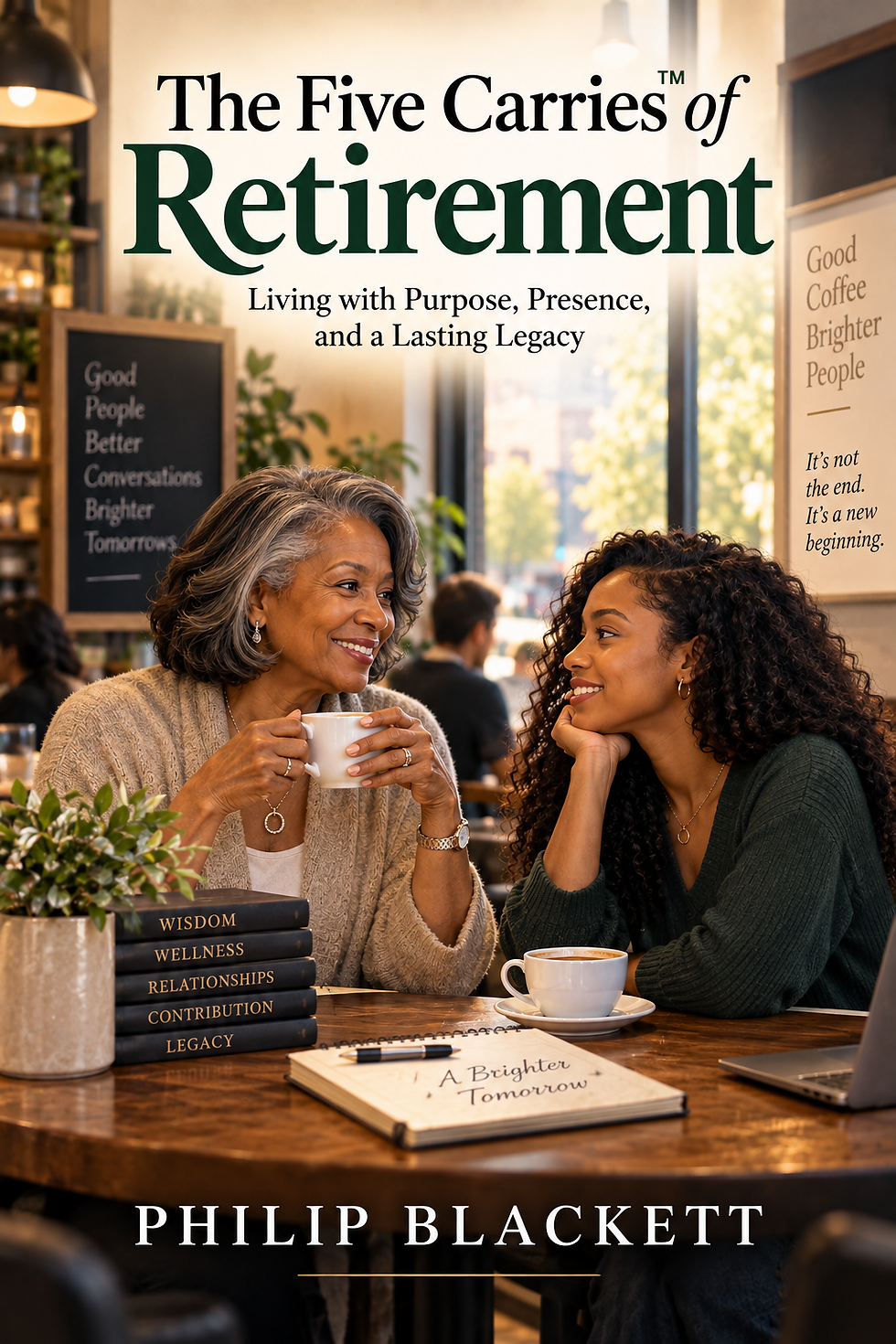
The Five Carries™ of Retirement: Carrying Purpose into Your Next Chapter
Best for: Adults approaching retirement, retirees, professionals transitioning out of full-time careers, and people reconsidering what their next chapter should look like.
Retirement is often framed primarily as a financial milestone.
How much have you saved?
What will your retirement income look like?
When can you stop working?
These are important questions.
But I believe there are other questions that deserve just as much attention.
Who will you be when your professional title no longer defines your day?
What relationships will receive more of your energy?
What responsibilities are you ready to release?
What wisdom do you want to pass forward?
And what will make this next chapter meaningful?
The Five Carries of Retirement explores the transition from career-centered responsibility toward a new understanding of purpose, identity, relationships, and legacy.
The story also introduces an important generational shift as Auntie Aaliyah becomes a mentor to Maya, continuing the cycle of wisdom, responsibility, and personal development.
Retirement doesn't necessarily eliminate responsibility.
It changes the nature of what we carry.
Carry Forward may involve mentoring younger generations, strengthening community relationships, or pursuing meaningful work without the pressures of a traditional career.
Carry Within becomes especially important as individuals consider how to sustain their health, curiosity, relationships, and sense of purpose throughout later life.
And Carry Up may involve honoring a lifetime of experiences without assuming that yesterday's identity must determine tomorrow's possibilities.
The central lesson: Retirement shouldn't simply be about what you're retiring from. It should also be about what you're retiring into.
Why I Chose to Write The Five Carries™ as Parables
There are plenty of books offering advice about productivity, leadership, parenting, personal development, and retirement.
I wanted to take a different approach.
I wanted readers to recognize themselves in the stories.
Because sometimes we resist advice when it's directed at us.
But when we see a character struggling with something familiar, we begin examining our own circumstances.
We see our manager in Daniel Mercer.
Our parenting struggles in Aaliyah Grace.
Our personal questions in her midlife transition.
Our hopes for the future in the retirement story.
And perhaps we recognize something else.
The value of having someone who can ask the questions we're avoiding.
That's one of the reasons Uncle Phil plays such an important role throughout the series.
He's not there to live Aaliyah's life for her.
He's there to help her recognize what she may not be seeing clearly.
And as the stories progress, that same spirit of mentorship continues through Auntie Aaliyah.
I've come to appreciate a simple thought:
Everyone needs an Uncle Phil or an Auntie Aaliyah in their lives.
Not necessarily someone who tells them what to do.
But someone who sees their potential, challenges their assumptions, helps them distinguish what matters from what doesn't, and encourages them to take responsibility for their own growth.
The Five Carries is designed to offer readers some of that same perspective.
Not by providing a perfect answer to every problem.
But by offering better questions.
Questions that can change how we understand our responsibilities.
How to Apply The Five Carries™ Framework to Your Life Today
You don't have to wait until you finish reading the book series to begin reflecting on The Five Carries.
Here's a simple exercise you can complete in approximately 10–15 minutes.
Step 1: Identify What You're Currently Carrying
Take a sheet of paper and write down the five directions:
Carry Up. Carry Down. Carry Across. Carry Forward. Carry Within.
Under each direction, list your current responsibilities.
For example:
Carry Up: Supporting aging parents, responding to senior leadership expectations, honoring important family commitments.
Carry Down: Raising children, coaching employees, mentoring someone younger.
Carry Across: Supporting a spouse or partner, maintaining friendships, collaborating with colleagues.
Carry Forward: Planning financially, developing future leaders, preparing children for independence, defining your legacy.
Carry Within: Improving your health, strengthening your mindset, getting adequate recovery, pursuing personal development.
Don't worry about organizing everything perfectly.
Just identify what's there.
Step 2: Identify Your Heaviest Carry
Look at your five lists.
Which direction currently requires the greatest amount of your attention, emotional energy, or time?
Is one area consuming so much capacity that you're neglecting another?
For example, are you carrying so much Down at work that you have little capacity remaining for your family?
Are you so focused on Carrying Forward that you're sacrificing your present well-being?
Are you neglecting Carry Within because every other direction feels more urgent?
This exercise isn't about guilt.
It's about awareness.
You cannot intentionally change what you haven't taken the time to recognize.
Step 3: Decide What Needs to Change
Now consider three organizing questions that sit at the heart of The Five Carries:
1. What am I carrying?
Recognize your current responsibilities, expectations, obligations, relationships, and personal commitments.
2. What am I going to carry?
Decide which responsibilities align with the person you're becoming and the future you want to build.
3. What am I finally ready to stop carrying?
Identify responsibilities, expectations, habits, beliefs, or burdens that no longer belong to you or no longer serve your life.
That third question may be the most difficult.
Because sometimes the things we need to release are the very things that once helped us succeed.
A belief about always needing to be strong.
A habit of saying yes to everyone.
A responsibility someone else is ready to assume.
A professional identity we've outgrown.
Or an expectation we've spent decades trying to satisfy.
Letting go isn't necessarily a sign of failure.
Sometimes it's a sign of growth.
Step 4: Take One Meaningful Action
Choose one small change you can make this week.
Perhaps it's having an honest conversation with your spouse about sharing responsibilities.
Delegating an assignment you've been reluctant to release.
Reconnecting with a mentor.
Developing a plan for a future career transition.
Or finally making time for your health and recovery.
You don't have to transform all Five Carries overnight.
Start by making one direction more intentional.
Then build from there.
The Five Carries™ and Sustainable High Performance: Why Carry Within Matters So Much
As a Sustainable High Performance Coach and founder of Life After 40, I believe there's a direct relationship between human capacity and the responsibilities we're expected to fulfill.
Think of your life as a vehicle.
Everyone notices how fast the vehicle moves and how far it travels.
But performance depends on what's happening under the hood.
You can demand more speed.
You can add more passengers.
You can increase the distance.
But if you ignore the condition of the vehicle, eventually performance suffers.
Human beings aren't machines.
Yet we frequently manage ourselves as though our capacity is unlimited.
We assume we can keep adding responsibilities without making corresponding investments in our physical, mental, emotional, and relational well-being.
The Five Carries challenges that assumption.
Carry Within matters because your ability to fulfill responsibilities in the other four directions depends, in part, on your capacity to function well.
This doesn't mean perfect health guarantees perfect performance.
And it doesn't mean self-care eliminates difficult circumstances.
It means sustainable responsibility requires an ongoing commitment to maintaining and developing the person carrying it.
That's why the framework complements the four pillars of Life After 40:
Nutrition: Fueling your body to support health, energy, and long-term well-being.
Exercise: Building the strength, movement, and physical capability to participate fully in life.
Mindset: Developing the beliefs, awareness, boundaries, and adaptability necessary to navigate change.
Recovery: Making room for rest, restoration, and resilience rather than treating exhaustion as a badge of honor.
The Five Carries adds another dimension to that work.
It invites us to consider not only how we strengthen our capacity, but also whether we're using that capacity to carry what matters most.
Because becoming more capable isn't always about becoming capable of doing more.
Sometimes it's about becoming wise enough to do less of what doesn't matter.
Frequently Asked Questions About The Five Carries™
What is The Five Carries framework?
The Five Carries™ is an original responsibility and personal development framework created by Philip Blackett. It identifies five directions of responsibility — Carry Up, Carry Down, Carry Across, Carry Forward, and Carry Within — to help people navigate their personal, professional, and relational commitments with greater clarity and intentionality.
What are The Five Carries?
The Five Carries are:
Carry Up: Responsibilities toward those above us or those who came before us.
Carry Down: Responsibilities toward people who depend on us.
Carry Across: Responsibilities shared with peers, partners, and colleagues.
Carry Forward: Responsibilities involving the future, succession, and legacy.
Carry Within: Responsibilities toward our own development, character, health, and well-being.
Is The Five Carries only for people over 40?
No. Although the framework emerged from Philip Blackett's Life After 40 mission, it applies across adulthood. The five-book series explores its applications to midlife, management, parenting, leadership, and retirement. Younger adults, professionals, parents, caregivers, and organizational leaders can also benefit from its principles.
Which Five Carries book should I read first?
You can begin with the book most relevant to your current life circumstances.
If you're navigating a personal transition or questioning your priorities, begin with The Five Carries of Midlife.
If you're managing employees, start with The Five Carries of Management.
If you're raising children, consider The Five Carries of Parenting.
If your responsibilities involve organizational influence and legacy, begin with The Five Carries of Leadership.
And if you're approaching or experiencing retirement, start with The Five Carries of Retirement.
The books share a common framework and interconnected characters, but each explores a distinct set of challenges. Midlife also serves as a prequel within the broader story.
How is The Five Carries different from traditional self-help or leadership books?
The Five Carries combines a practical five-direction framework with fictional parables.
Rather than focusing exclusively on productivity, motivation, or achievement, the series examines the responsibilities people carry, the relationships those responsibilities affect, and the human capacity needed to sustain them.
Its central focus is not merely accomplishing more. It is becoming more intentional about what deserves to be carried.
Where can I buy The Five Carries book series?
The Five Carries™ book series by Philip Blackett is available on Amazon in Kindle, paperback, and hardcover formats. You can also learn more about the books, framework, and related resources at FiveCarries.com.
The Future of The Five Carries: More Than a Book Series
My vision for The Five Carries extends beyond publishing five books.
I see the framework as a practical language people can use to start more meaningful conversations about responsibility, boundaries, relationships, leadership, and personal growth.
Imagine a manager asking an overwhelmed employee, "Which direction are you carrying too much right now?"
Imagine parents discussing which responsibilities their children are ready to begin carrying independently.
Imagine an executive team examining how well its leaders Carry Up, Down, Across, Forward, and Within.
Imagine someone preparing for retirement asking, "What responsibilities am I ready to release, and what meaningful responsibilities do I want to embrace next?"
Or imagine a couple sitting down together to discuss not just their goals, but everything they're currently carrying to pursue them.
These conversations have the potential to change how people see themselves and the people around them.
That's why I'm developing The Five Carries not only as a book series, but also as a foundation for coaching, group discussions, leadership development, workshops, and organizational consulting.
Because I believe that when people become more intentional about their responsibilities, they can make better decisions about how they spend their limited time, energy, and attention.
And those decisions affect more than their own lives.
They influence families.
Workplaces.
Communities.
And future generations.
One Last Question: Are You Carrying What Matters Most?
I want to leave you with one final thought.
At different points in our lives, we often assume success requires us to carry more.
More responsibilities.
More accomplishments.
More expectations.
More commitments.
And sometimes that's true.
Growth can bring greater responsibility.
But maturity should also bring greater discernment.
The wisdom to recognize what truly matters.
The humility to ask for help.
The courage to establish boundaries.
The patience to develop others.
The foresight to prepare for the future.
And the discipline to care for ourselves along the way.
You won't carry the same things at 60 that you carried at 40.
You shouldn't carry the same things at 40 that you carried at 25.
Your responsibilities will change.
Your relationships will evolve.
Your circumstances will shift.
And your definition of success may look very different from what it once did.
The goal isn't to spend the second half of your life proving how much you can carry. It's to become wiser about what you choose to carry.
That's why I wrote The Five Carries.
Not simply to help people become better managers, parents, leaders, or retirees.
But to help them become more intentional human beings.
People who recognize that a meaningful life isn't defined only by what we achieve.
It's also defined by how we care for others, what we pass forward, what we have the courage to release, and who we become in the process.
And if you're someone who has spent years carrying responsibilities for everyone else, I hope these books help you remember something important.
You matter, too.
So before you take on your next responsibility, accept your next promotion, set your next goal, or prepare for your next chapter, consider asking yourself three questions:
What am I carrying?
What am I going to carry?
And what am I finally ready to stop carrying?
Your answers may help you see the next chapter of your life differently.
Because the second half of life isn't simply about carrying more of what you've always carried.
It's about choosing what deserves to come with you.
Let's thrive in the second half.
— Philip Blackett
Founder, Life After 40® | Creator and Author, The Five Carries™
Read The Five Carries™ Book Series on Amazon
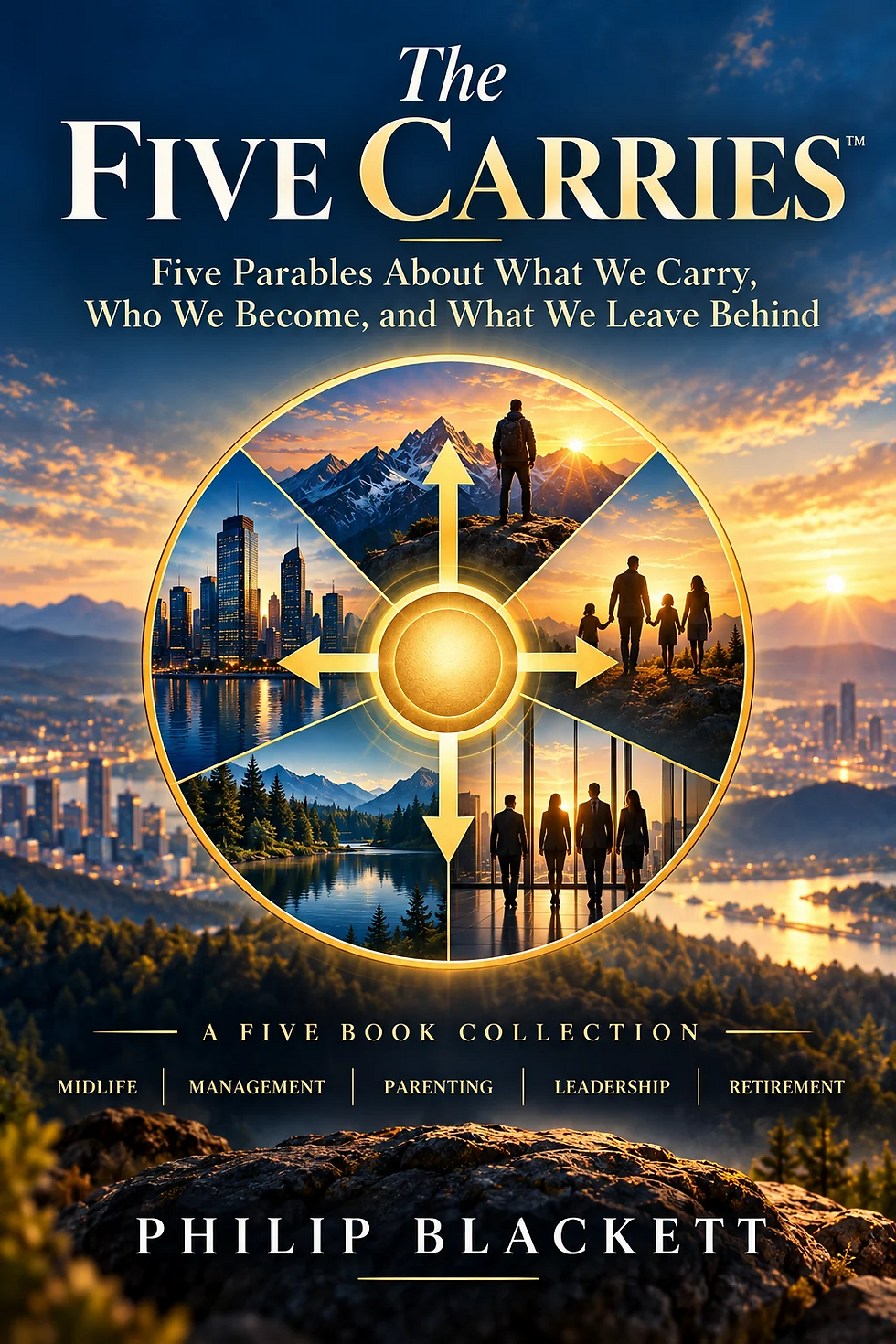
Five books. Five areas of life. One framework for carrying what matters most.
Whether you're navigating midlife, managing a team, raising children, leading an organization, or preparing for retirement, there's a story within The Five Carries that speaks to the responsibilities you carry.
Discover the five books by Philip Blackett, available on Amazon in Kindle, paperback, and hardcover formats.
You can also learn more about the framework, books, and upcoming resources at FiveCarries.com.
The Five Carries™ — Because what you carry matters. And so does the person carrying it.